

AI hot takes are everywhere right now. We know. It’s a conversation that has become constant, and in many cases, repetitive.
We’re still in the early chapters of what AI platforms are going to become. When they first entered the scene, they felt like tools for quick answers and niche use cases. Now, they’re evolving into hot spots where everyday decisions are starting to take shape, especially when it comes to shopping.
As consumers grow more comfortable using AI to evaluate products, an important question follows: how do you introduce monetization without disrupting the very experience that made users show up in the first place? Because once monetization enters the picture, everything is affected. So what happens to design? Placement? Trust? The overall UX?
Throughout this piece, we explore how users feel about the integration of ads in AI chat results. In order to do that, we conducted a Useberry test with 1,002 U.S. participants between the ages of 18–65, with the goal of understanding how different ads perform within an AI chat environment, and which integrations users prefer, engage with, and trust.
Throughout the process of designing the study, we found it counter-effective to limit ourselves to testing a single ad format inside an AI chat experience. Instead, we built eight distinct prototypes to better understand how both format and placement influence engagement.
Participants were then asked a series of questions aimed at uncovering what drives their engagement with ads, how sponsored content impacts their trust in AI environments, and how comfortable they feel seeing ads in exchange for free access to an AI platform.
A couple of noteworthy patterns emerged, and the consumer insights that follow are less about which test performed best but rather more about what the data shows us regarding how publishers could monetize these AI environments without undermining the experience itself.
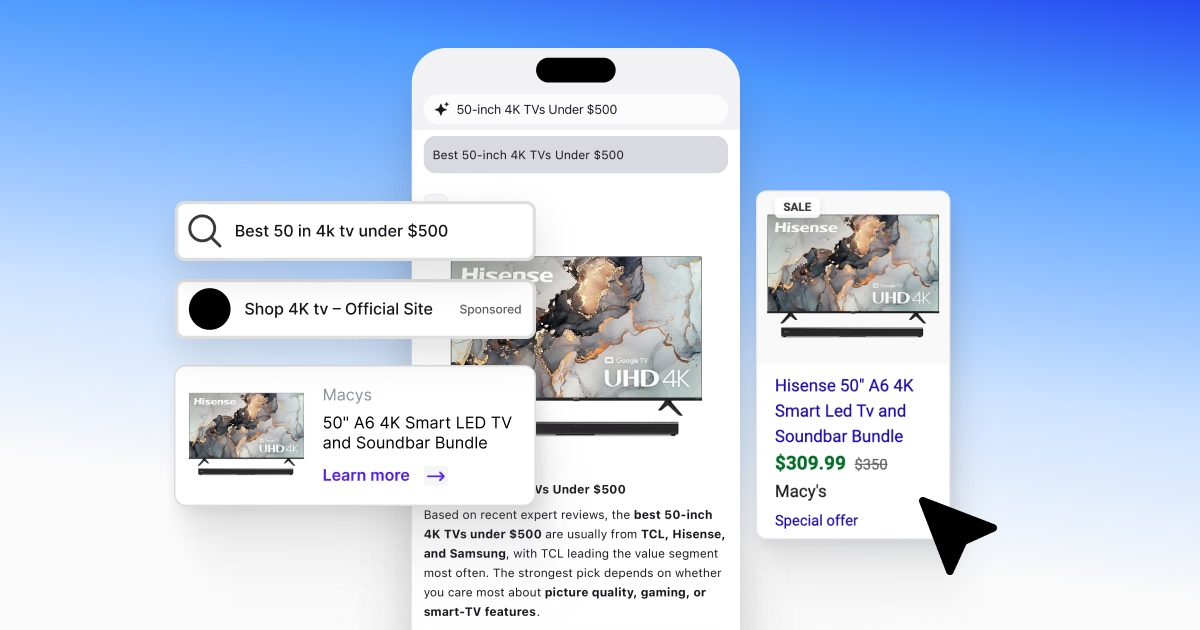
To evaluate ad format, we developed four variations of an AI platform, each featuring a different ad type:
After respondents interacted with each variation, we noticed that nearly 80% of participants in the “Related Products” cohort clicked on product ads, making it the highest-performing and most-preferred across all variations.
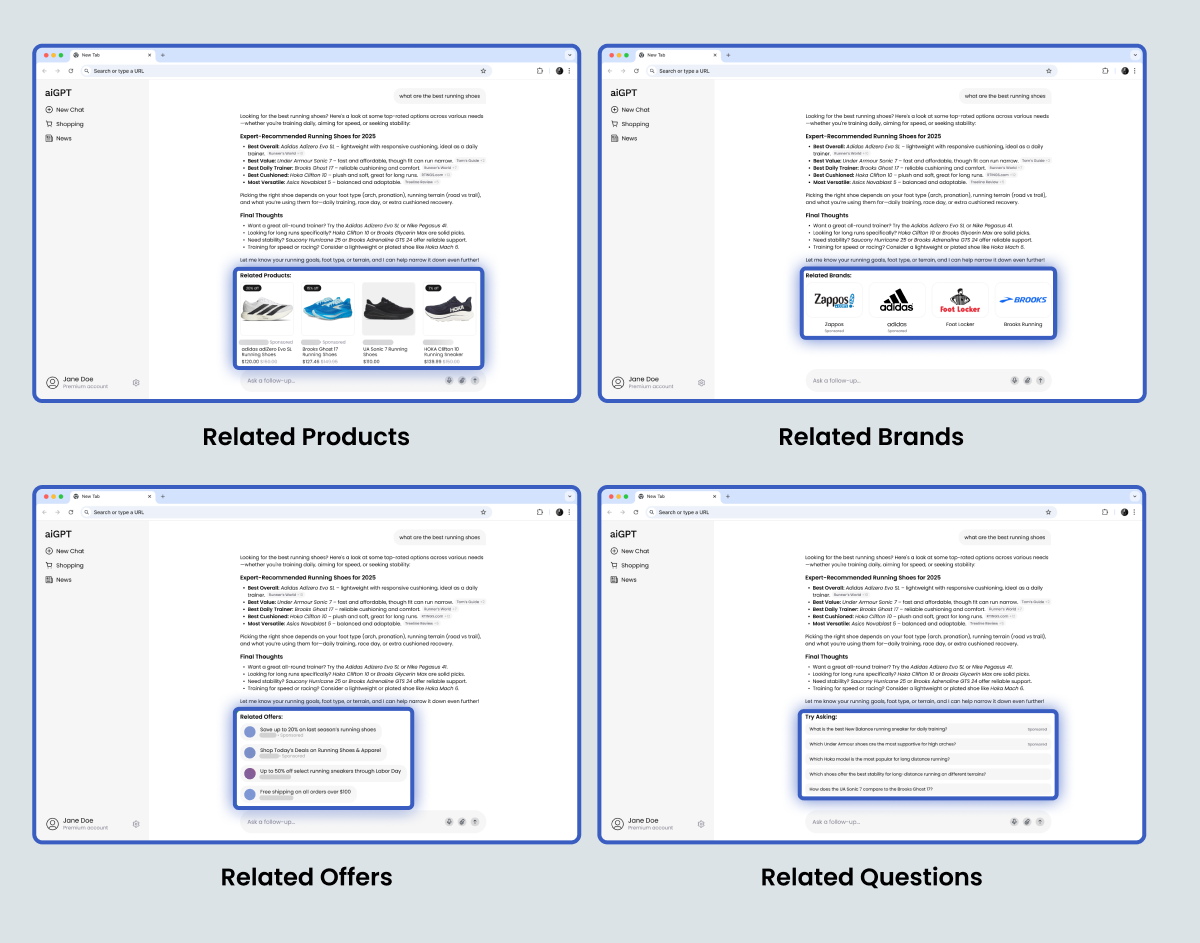
Participants consistently pointed to visuals and scanability as key drivers of engagement, especially when the Product ads included price, reviews, and direct links. That’s not to say that other formats lack potential, because they certainly can maintain a sense of novelty within the interface when used interchangeably. Rather, product-focused ad units appeared to align more closely with the detail-focused mindset users bring into AI shopping.
To evaluate placement, we developed four additional AI chat prototypes. In these variations, ads appeared either:
From this, an equally important pattern emerged. The cohort that experienced Product ads below the chat response showed the highest placement-level engagement at 72%. This placement location was also the most preferred across all cohorts at 31%.
Participants favored when ads appeared at the bottom of their AI chat experience the most because it offered the clearest separation between the information they requested and the ad unit they were served. This distinction allowed the experience to feel more natural and less intrusive, and was described as easier to engage with because it didn’t interrupt the participants flow of the experience.
It’s also important to note that placement alone doesn’t drive performance. Across previous tests, we’ve consistently seen that the strongest predictor of engagement inside an AI platform is relevance. In fact, 40% of participants cited relevancy as the number one driver of clicking on an ad. When the ad matches exactly what a user is looking for, it feels additive to the experience rather than disruptive.
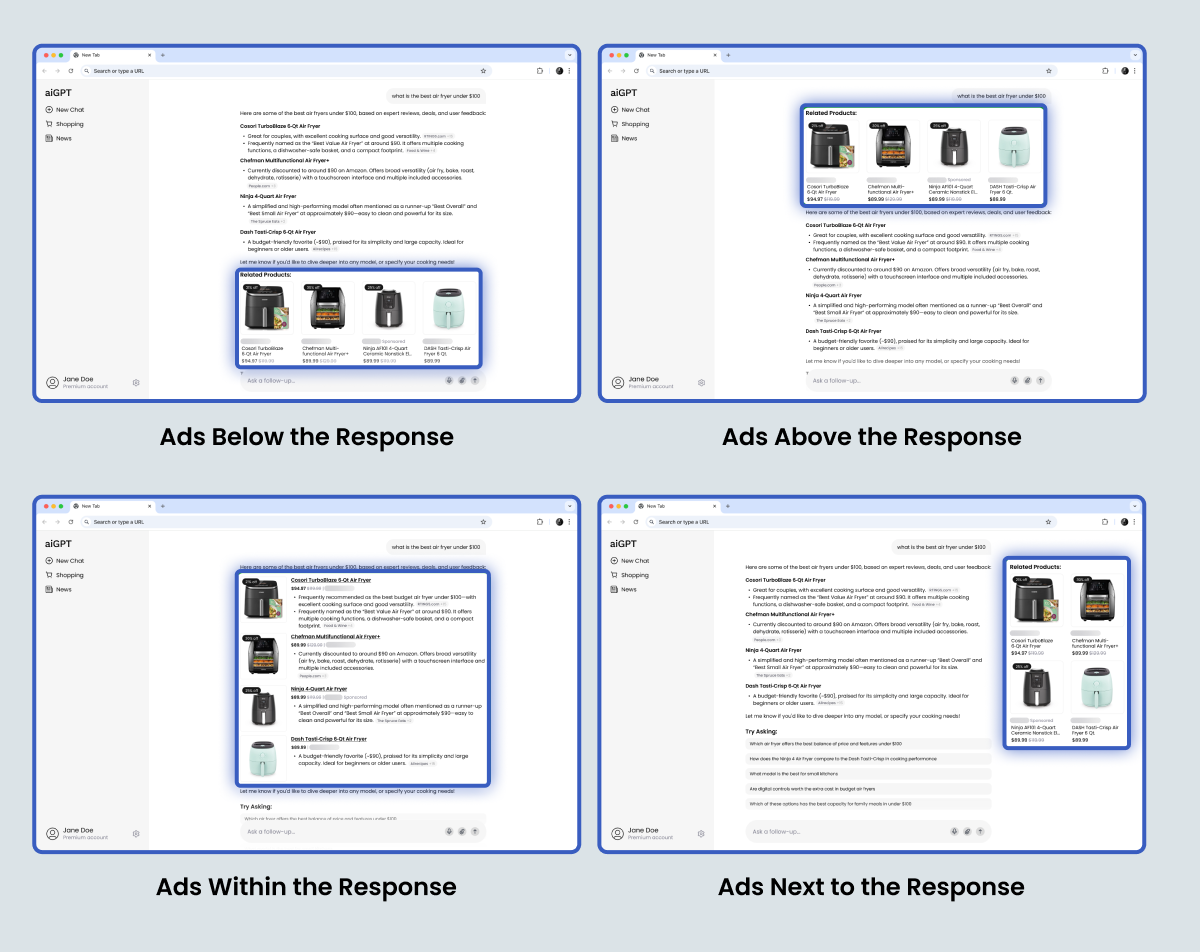
But it is safe to say where ads are presented in the chat changes how they’re interpreted. In AI chat environments, making sure to place ads below the chat response preserves both engagement and user comfort, showing us that thoughtful placement is just as important as the format itself.
One of the most common concerns among industry publishers is whether introducing ads will erode trust in the chat response, and it’s a fair concern given the lack of clarity surrounding it.
The data, however, is more clear-cut with nearly 3 out of 5 participants saying ads don’t impact their trust in AI chat at all. An additional 24% reported that seeing sponsored products actually increased their trust in the platform, particularly when the ads featured brands they knew. To top it off, 60% expressed that paid sponsorship elements were not enough to question the credibility of the platform.
That being said, skepticism still exists. Roughly 30% of participants reported that ads would make them lose trust in the response. Those who raised some eyebrows cited intrusiveness and the potential for bias as primary reasons they would lose trust in an AI response when sponsored content felt shoehorned into the response.
Although it may feel uncomfortable for some publishers to introduce monetization into environments powered by these very intelligent systems, providing clarity to users makes a world of difference. Being transparent about why a platform is monetized and reinforcing that ads do not influence the AI’s responses is the first step to earning a gold star.
Taken together, the consumer insights that have been gathered through this study prove we’re still at a valuable entrance point in the AI monetization race. The norms for advertising inside these platforms haven’t been cemented yet, which creates a rare moment for publishers to define them intentionally.
With the right format, thoughtful placement, and a relentless focus on relevance, monetization does not have to compete with your UX. It can strengthen it. The publishers who move carefully and deliberately now won’t just participate in this shift; they’ll be the ones who help shape what responsible AI monetization looks like moving forward.
We help brands maximize reach and improve efficiency so that you can grow market share, outpace competitors, and win the search.






.jpg)